By this time in the process, a community has exerted considerable political capital, energy, and funds to conclude to move forward in the process. Through the feasibility process, the community has most likely significantly narrowed its strategy decisions.
Determine community role
As noted early in this handbook, community involvement can range from cheerleader to direct public funder/grant application supporter to community-owned ISP. As AAPB is a strong proponent of public ownership of some or all of the network elements, this handbook will focus on public ownership strategies.
In the community profiles, readers will note that some public entities have moved incrementally into the broadband ownership arena, while for others, a publicly owned broadband network was the original and primary goal. The former may have begun with infrastructure investments primarily planned to meet the local government or utility’s general internal operational needs or that of a public electric utility before expanding access to others. The latter have set out to create a broadband utility.
A broadband network has many components. In general, the farther the public entity deploys network and equipment toward the end customer, the higher the costs but also the increased likelihood that the network will be ubiquitous. A public entity could choose any of the following scenarios:
1. Install Conduit or Duct Only
Strategies
- Communities may have deployed conduit in “dig once” strategies as part of road construction/reconstruction projects or deployed multiple ducts when building a public-sector/anchor institution fiber project.
- Communities may choose to deploy a conduit network as an incentive to encourage competition by enabling multiple ISPs to serve the community, especially in states with significant restrictions on public-sector broadband investment.
Benefits
- Communities can make the conduit available to one or more private ISPs to reach new markets at more affordable deployment costs. With proper engineering, multiple ISPs can use the same duct or micro-ducts within the conduit. This would be an “open access” conduit strategy.
- A conduit-only network can be a relatively low ancillary cost to a road construction project.
2. Open-Access, Middle-Mile Fiber Network
Strategy
- Communities can deploy multi-strand fiber-optic networks along major routes in their cities or counties. This type of network could cover a small geography like a downtown or industrial park, or involve hundreds of miles of fiber, possibly linking to adjacent counties. The public would likely choose to lease dark fiber to ISPs that would extend the fiber to customers.
Benefit
- Most networks of this type are constructed to support local/regional governments and anchor institutions with the additional benefit of enabling competitive providers with affordable fiber access to reach difficult-to-serve areas, like downtown urban areas with their crowded utility rights of way and concrete streets and sidewalks and as well as low-density rural areas.
3. Open-Access, Last-Mile Fiber-to-the-Curb or -Pole Network
Strategy
- The public sector could construct a fiber network that terminates at the curb (buried) or extends to the pole (aerial) and lease capacity on the network to one or more private ISPs that would extend the fiber drop to the home or business.
Benefits
- The public sector provides a platform, at significant cost savings versus a full fiber-to-the-home (FTTH) network, for enhanced and competitive broadband with minimal capital expense for the private-sector ISP’s FTTH network. The private sector assumes the cost for the fiber drop and fiber termination electronics.
- By selecting this option, the first private-sector ISP to market receives a competitive advantage over later arrivals. The first ISP to market would be able to charge broadband-hungry customers for the fiber drops while those same customers would be less likely to assume that cost for a similar fiber service from a new provider.
4. Open-Access, Fiber-to-the-Home (FTTH) Network
Strategy
- A public entity could construct and own the FTTH network reaching from the central office to the home or business, including the electronics at the home. The public entity would lease network capacity to one or more private ISPs. The public entity or a neutral third party would operate and maintain the network.
Benefit
- Generally, the ISPs would pay the network owner on a per-customer basis, allowing easy and low-capital-cost market entry. Customers would be able to switch ISPs via an online portal to obtain more affordable, reliable, or unique value-add services.
5. Public Utility Fiber-to-the-Home Network with a Single Public ISP
Strategy
- A public entity could construct and own the FTTH network reaching from the central office to the home or business, including the electronics to the home. The public entity would serve as the ISP for all customers. The ISP could decide to offer dark fiber and other special customer services to key customers.
Benefit
- By owning and operating the network as a public ISP, the community has strong control over total network operations, including deployment strategies, financing, sales and marketing, and pricing. Communities can be innovative in digital equity strategies and maximize the economic potential of the network for community, economic, and workforce development.
6. Public Utility Fiber-to-the-Home Network with a Single Private ISP
Strategy
- A public entity could construct and own the FTTH network reaching from the central office to the home or business, including the electronics to the home, then select a private ISP partner to deliver retail internet services to community residents and businesses.
Benefit
- The community benefits in the long term by owning the network assets while being relieved of the responsibility of delivering retail services to its residents. Smaller communities may not have the necessary scale to stand up a complete customer-service initiative. Other communities have a preferred community-centric private ISP partner that is well known for excellent customer service.
Select project partners
Broadband projects involve a range of public- and private-sector partners determined by the selected community role noted above. Some may debate whether these are partnerships or customer relationships. While some of these may be short-term engagements—like the feasibility consultant or construction contractors—many of these will likely be long-term relationships. Agreements should be designed with exit provisions should the partnerships become suboptimal.
Prospective partners include:
Users
- Other public entities, including state agencies, local and regional anchor institutions, and tribal governments
- Major private-sector users, like multi-location employers
Network Partners
- Feasibility, design, equipment, and construction
- Vendors selected through appropriate competitive processes provide consultation and services necessary to design, equip, and build the network
- Operations
- Installation, customer care, billing, fiber locations, etc.
- Marketing
- One or more vendors to design and/or implement marketing strategies to attract network customers
- ISP(s)
- Contract with one or more ISPs to offer internet services on the network, either as the agent of the public entity, as a sole provider on a network lease basis, or in a competitive environment where multiple ISPs are delivering services
Obtain financing
Financing availability and terms strongly influence the financial success of a network. It is critical to create a finance team that understands public-sector infrastructure finance as well as the operational requirements for financing. See the discussion on page 27.
Construct the network
Public entities are generally used to implement large-scale infrastructure projects with the use of private contractors, but they generally lack telecommunications infrastructure experience. If there will be a private ISP operating the network, it should be a part of the construction team so that the network meets its needs.
Implement marketing and sales strategy
In many of the above scenarios, there is little need for sales and marketing consulting services. However, in any case where the public entity will be the ISP, there is a need for a robust sales and marketing effort. Some existing public utilities may have strong communications capacities in place that can be utilized, alone or in conjunction with specialty marketing firms with broadband marketing expertise.
The profiles in this handbook illustrate the wide range of roles from which a community can choose. Defining community and partner roles is an important task that is dependent on community policy choices, implementation capacity, and goals. Some communities choose to limit their involvement to legal agreements and provision of funds. Others choose to finance, construct, and operate a network. There is no cookie-cutter route to follow to create a community-owned network, but rather a range of models from which to choose and/or create a unique approach.
 A public network owner could deploy a single technology or multiple technologies to cover its service territory. Coverage could be an urban residential neighborhood or a downtown area or business park, the entirety of a small town or large city, or one or more rural counties. Selected technologies could be FTTH, Wi-Fi, or fixed wireless, each with a different set of bandwidth capabilities, deployment timelines, and capital and operating expenses. The right technology choices depend on the community’s specific goals.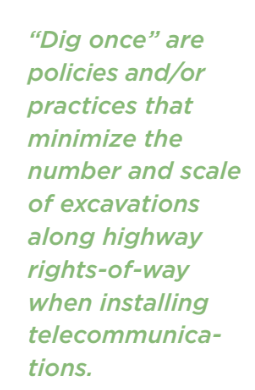
 Own Your Internet