Fairlawn, Ohio
Population 7,710
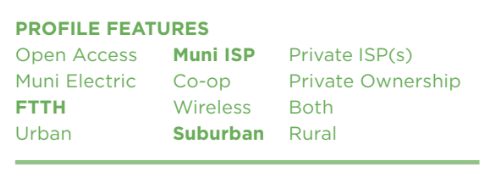 A leading hotelier and business leader testified, “My guests would prefer to lose the hot water rather than the internet.” This statement helped Fairlawn, Ohio, leadership envision a fiber-to-the-home (FTTH) network called FairlawnGig as essential infrastructure, just like water, sewer, and roads. The Fairlawn team—led by Mayor William Roth, Jr., a blue-ribbon task force, and professional staff—committed to that vision and combined it with strong business and network planning. The result is ubiquitous, affordable, world-class broadband, with every resident and every business in Fairlawn able to access gigabit internet service at $55 per month. FairlawnGig recently reduced the price due to the financial success of the network; the goal is community connectivity, not profits.
 Like most communities seeking better internet service, Fairlawn first approached incumbent providers to explore a partnership to invest in FTTH connectivity. Like most communities, that approach came up empty. Nevertheless, the community was determined to achieve its vision.
Failing to attract an incumbent as a partner, the city decided that it would build and own the infrastructure and then contract with a private ISP to operate the network and sell retail services. This approach would help the city avoid the anticipated steep learning curve of becoming a reliable ISP and entering the competitive marketplace. While many public broadband providers emerge from existing municipal electric utilities, Fairlawn started from its more limited utility experience in providing the standard city services of sewer and water.
Just six months after selecting an operating partner, the community realized that only the City of Fairlawn could ensure the quality customer service standards that Fairlawn residents expected. The city assumed complete control of operations and has not looked back. More than 60 percent of households now subscribe to FairlawnGig service, and that number is increasing. Customer satisfaction levels are over 90 percent and rising, and the community is attracting residents and business investment like never before. Residents appreciate the enhanced customer service. FairlawnGig is locally owned—and locally delivered by friends and neighbors.
FairlawnGig’s success is tied to keeping it simple: Build and maintain a great network, deliver broadband service everywhere, and offer a gig at an affordable price. FairlawnGig offers only internet service avoiding more complicated video and voice services. They do support customers as they learn how to use streaming and other applications. The company’s installers ensure that new customers can connect all their devices to the network throughout the house and even get their streaming apps working. FairlawnGig even built a “living room” at its offices to provide low-stress individualized training sessions.
The community and economic development benefits of FairlawnGig are accelerating. Housing values are increasing faster than in adjacent communities. An international technology firm and a new hospital have recently located to the community based on network quality. Crucially, business customers tell the city that the network helps their local businesses grow.
A leading hotelier and business leader testified, “My guests would prefer to lose the hot water rather than the internet.” This statement helped Fairlawn, Ohio, leadership envision a fiber-to-the-home (FTTH) network called FairlawnGig as essential infrastructure, just like water, sewer, and roads. The Fairlawn team—led by Mayor William Roth, Jr., a blue-ribbon task force, and professional staff—committed to that vision and combined it with strong business and network planning. The result is ubiquitous, affordable, world-class broadband, with every resident and every business in Fairlawn able to access gigabit internet service at $55 per month. FairlawnGig recently reduced the price due to the financial success of the network; the goal is community connectivity, not profits.
Like most communities seeking better internet service, Fairlawn first approached incumbent providers to explore a partnership to invest in FTTH connectivity. Like most communities, that approach came up empty. Nevertheless, the community was determined to achieve its vision.
Failing to attract an incumbent as a partner, the city decided that it would build and own the infrastructure and then contract with a private ISP to operate the network and sell retail services. This approach would help the city avoid the anticipated steep learning curve of becoming a reliable ISP and entering the competitive marketplace. While many public broadband providers emerge from existing municipal electric utilities, Fairlawn started from its more limited utility experience in providing the standard city services of sewer and water.
Just six months after selecting an operating partner, the community realized that only the City of Fairlawn could ensure the quality customer service standards that Fairlawn residents expected. The city assumed complete control of operations and has not looked back. More than 60 percent of households now subscribe to FairlawnGig service, and that number is increasing. Customer satisfaction levels are over 90 percent and rising, and the community is attracting residents and business investment like never before. Residents appreciate the enhanced customer service. FairlawnGig is locally owned—and locally delivered by friends and neighbors.
FairlawnGig’s success is tied to keeping it simple: Build and maintain a great network, deliver broadband service everywhere, and offer a gig at an affordable price. FairlawnGig offers only internet service avoiding more complicated video and voice services. They do support customers as they learn how to use streaming and other applications. The company’s installers ensure that new customers can connect all their devices to the network throughout the house and even get their streaming apps working. FairlawnGig even built a “living room” at its offices to provide low-stress individualized training sessions.
The community and economic development benefits of FairlawnGig are accelerating. Housing values are increasing faster than in adjacent communities. An international technology firm and a new hospital have recently located to the community based on network quality. Crucially, business customers tell the city that the network helps their local businesses grow.
 “Cooperation
  Own Your Internet