Introduction

Residents and businesses are asking community leaders for competitively priced, affordable, and reliable broadband services to support all connectivity-dependent uses, including work, education, health care, and business—and deliver ever-increasing capacities. In today’s world, that means gigabit per second (Gbps) symmetrical services, far beyond the Federal Communications Commission’s outdated 25 megabit per second (Mbps)/3 Mbps national standard. Clearly, communities will not be competitive in attracting new residents and business investment without world-class broadband.

There are multiple pathways, ranging from Active to Proactive, to better community broadband infrastructure. Here are some examples:
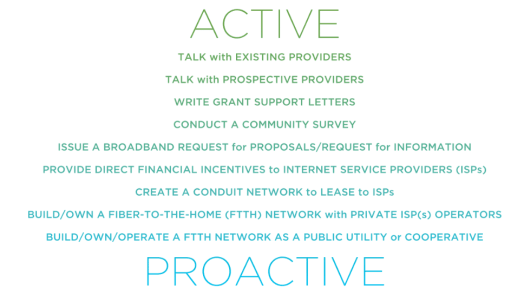
ACTIVE
Talk with existing providers
Talk with prospective providers
Write grant support letters
Conduct a community survey
Issue a broadband request for proposals/Request for information
Provide direct financial incentives for Internet Service Providers (ISPs)
Create a conduit network to lease to ISPs
Build/own a fiber-to-the-home (FTTH) network with private ISP(s) operators
Build/own/operate an FTTH network as a public utility or Cooperative
PROACTIVE

This handbook focuses on the steps that can lead to a publicly owned broadband network. While every community will take its own unique path, there are well-established critical steps necessary on a successful decision-making and implementation journey.

There is not a single definition of public broadband. While some consider a public broadband network to be only networks owned and operated as a public utility with the public entity as the Internet Service Provider (ISP), the AAPB includes many public-private partnerships and cooperatives under the category of “public.” For the AAPB, the common denominator is that the community owns some portion of the communications network infrastructure. Public-private partnerships in which the public role is limited to providing a financial subsidy to a private-sector network owner/operator would not be considered in this definition.

Public officials are often too quick to discount the public broadband option. Discarding this option too early bypasses consideration around a wide array of public network benefits and surrenders a valuable negotiating tool in dealing with incumbent providers.

Hesitancy factors:

  • Lack of technology knowledge
  • Time and expense necessary to determine feasibility
  • Uncertain path forward
  • Fear of taking on significant new government responsibilities
  • Fear of multimillion-dollar network construction costs and public debt
  • Incumbent provider lobbying
  • Public-sector broadband challenges
  • Lack of awareness of success stories

Communities may find that by just considering a public broadband network, they may bring increased attention from incumbent providers and stimulate short-term network investments and promises of more upgrades. These public discussions also attract prospective ISP partners and discussions of public-private partnership.

Forward

For decades, public broadband networks have been successfully serving hundreds of communities with fast, robust, and affordable internet access. Unlike private-sector networks, municipal, tribal, and other community- and member-owned broadband networks are focused on ensuring universal, robust connectivity at affordable prices. The results have been remarkable. Small cities and regions like Chattanooga, Tennessee; Wilson, North Carolina; Morgan, Utah; and the Massachusetts Berkshire region have been transformed into vibrant centers of economic opportunity, education, and culture.

The COVID-19 pandemic awakened a new interest in public broadband. In an instant, children had to attend classes online, workers had to do their jobs virtually, families and friends had to connect via the internet, and the sick had to visit with their doctors remotely. When it became clear that private network operators were not going to ensure that everyone had an affordable and fast broadband connection, cities and towns took matters into their own hands and started building their own networks.

The growth of public broadband networks has been striking. The Institute for Local Self-Reliance recently reported that as of the end of 2023 there were nearly 450 community-owned networks across the United States, with dozens more projects in the planning and construction phases. In addition, the National Rural Electric Cooperative Association reports that there are more than 200 member-owned cooperative broadband networks. Public broadband networks consistently score at the top of customer satisfaction surveys—indeed, Longmont, Colorado’s NextLight was named PCMag’s Reader’s Choice award for Top Home ISP for 2023. With communities looking to promote economic development, build smart cities, and attract new residents, it is clear that this is public broadband’s moment.

Yet for all of the progress that public broadband networks have made in recent years, there are still many communities that want to explore network ownership but don’t know where to begin. That’s why the American Association for Public Broadband (AAPB), partnering with the Benton Institute for Broadband & Society, has developed this handbook. It sets out, in simple terms, the key decisions a community and its leaders must make, as well as the concrete steps they must take to build a successful public network. The handbook also provides a list of resources that can help with both—including law firms, financial advisors, public relations firms, construction firms, equipment vendors, grant applications and management platforms, operational and business support systems, and firms that design, build, and operate networks.

Developing and executing a plan to build a public network is not an easy task for any community. There will be challenges—be they logistical, technical, financial, or political. But the economic and social benefits of community network ownership will certainly be worth it. This handbook is designed to help you address those challenges so your community can benefit from everything that broadband enables.

An online counterpart to this handbook will be updated with more information and resources. In the near future, AAPB will add a mentorship program that seeks to pair a community considering building a public network with another that has successfully done so. The goal is to double the number of public networks over the next five years. Given the resources available for broadband deployment and the increased interest in the public broadband model, AAPB believes that this goal is achievable.

I want to thank Bill Coleman for his diligence and patience in taking on this project, Kevin Taglang for his careful eye and thoughtful edits, Adrianne Furniss for putting Benton’s resources behind this handbook, and the AAPB board—Angela Bennink, Bob Knight, Scott Menhart, Kimberly McKinley, and Peggy Schaffer—for having the vision and the drive to create this vital organization.

Gigi Sohn
Executive Director
American Association for Public Broadband